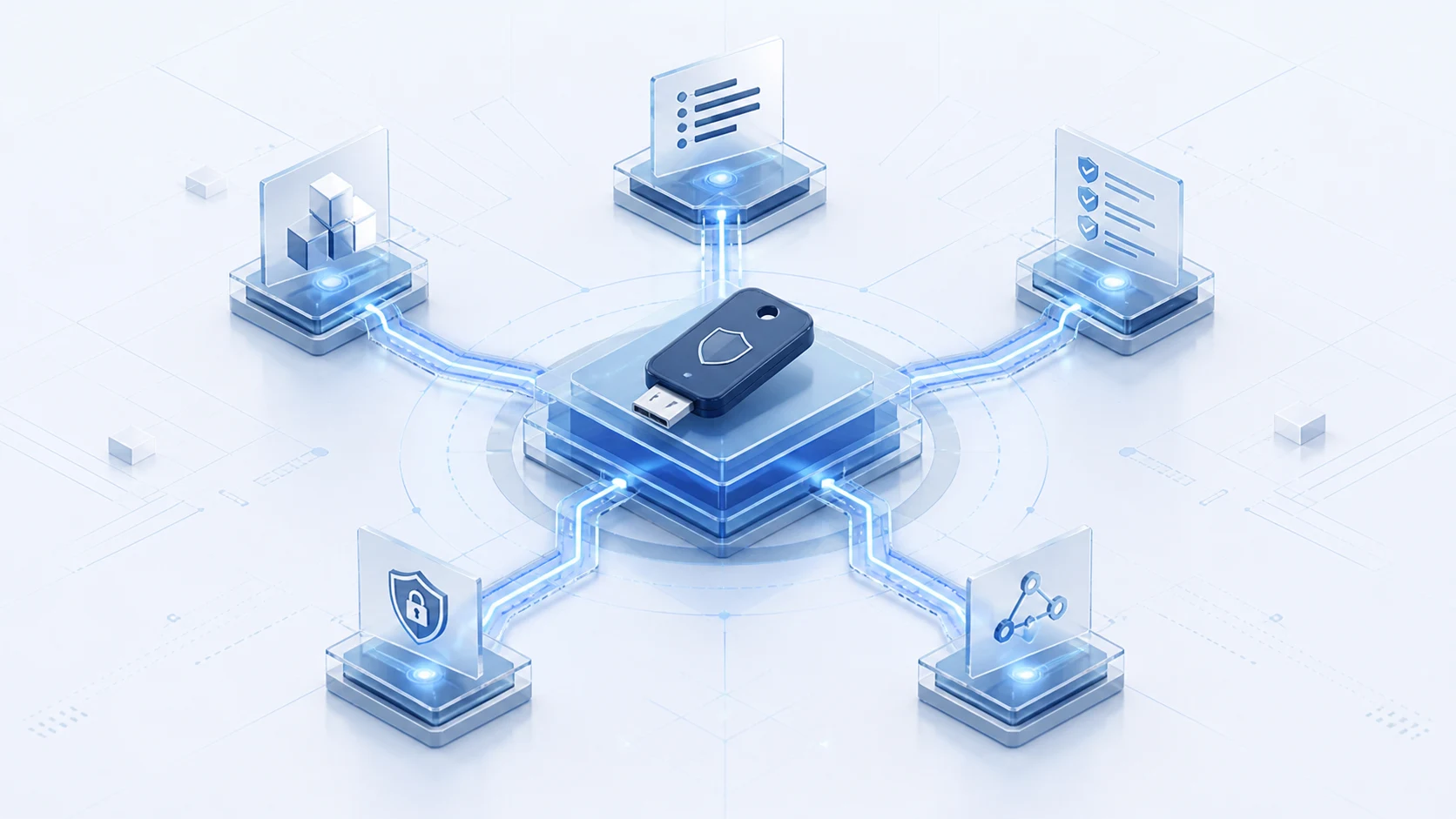
In the escalating arms race of forgery and fraud detection, standard visual inspections are no longer sufficient. Most legacy verification systems, commercial devices, and human eyes natively process only visible, white light. Under these conditions, reflecting light off an identity document might reveal certain holograms or basic visible security markers. However, authenticating the complex, unique security features embedded in modern IDs requires looking far beyond the visible spectrum. Multi-spectral analysis has emerged as a critical, authoritative technique that uses various wavelengths of light to verify the true authenticity of an identity document and the individual presenting it.
While multi-spectral analysis is a powerful tool, relying solely on isolated checks leaves organizations vulnerable. At Trust Swiftly, we provide options for advanced multi-spectral checks combined with dynamic AI correlation, ensuring your identity verification process is comprehensive, adaptive, and highly secure.
The Commoditization of the UV Spectrum
It is a common misconception that invisible spectral bands are impossible for counterfeiters to replicate. In reality, illicit marketplaces and the dark web have largely commoditized the ultraviolet (UV) spectrum, particularly at the 365nm wavelength. Today, almost all modern fake IDs incorporate UV-reactive elements because the necessary inks and specialized printers are relatively easy to procure and apply at scale. Many businesses in the US still rely on rudimentary UV blacklights to validate IDs, ensuring only that a document "glows" under the light. This outdated approach offers a false sense of security. To detect highly sophisticated counterfeits, verification requires specialized hardware capable of analyzing deeper, more complex spectral bands.
Deep Dive: Infrared (IR) Analysis and the Passport Test
To illustrate the power of multi-spectral analysis, let's examine a United States passport viewed under 850nm near-infrared (NIR) light. Legitimate passports and government-issued IDs are printed using highly regulated, standard-compliant security features. Under IR light, standard photographic inks become transparent, while specialized carbon-based inks absorb the infrared light and appear starkly bold.
IR-Transparent Inks: On a genuine US passport, the visible inks used for the primary portrait disappear completely under 850nm IR light.
IR-Absorbing Inks: Conversely, the Machine Readable Zone (MRZ) at the bottom of the passport, along with specific hidden identifiers, are printed with carbon-based (B900) ink. These sections become highly contrasted and distinct under IR light.
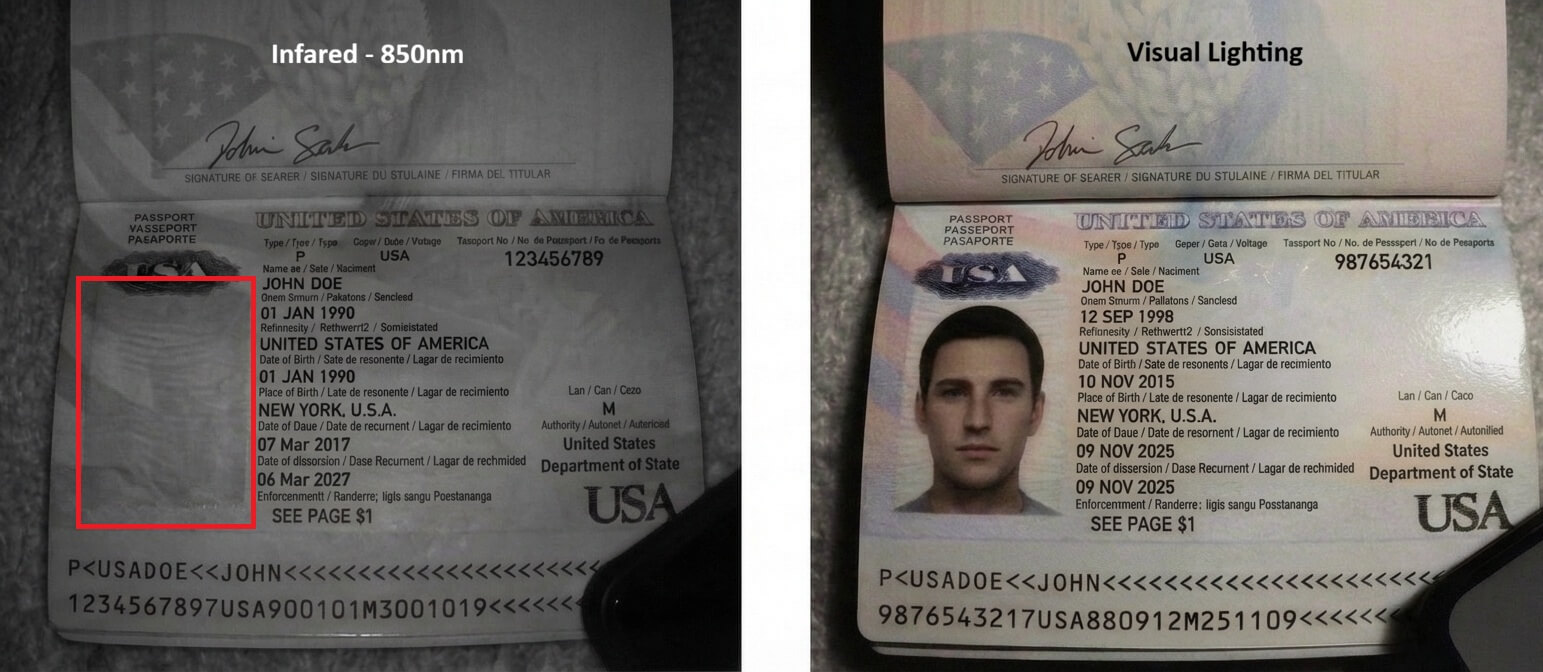
If a counterfeit passport is cheaply printed using standard commercial inks, the portrait will stubbornly remain visible under IR light. By utilizing AI to compare the visual light capture against the IR capture, Trust Swiftly can immediately flag the counterfeit with near-perfect accuracy.
Securing the User: Thermal Imaging and Liveness Detection
Multi-spectral verification extends beyond the document to the user presenting it. A growing threat in biometric authentication is the use of hyper-realistic silicone masks or deepfakes, known in the industry as Presentation Attacks. Trust Swiftly mitigates this risk by integrating thermal imaging for advanced liveness detection. Thermal cameras detect the natural heat signatures of a live human face. A silicone mask or digital screen lacks a complex human thermal signature, allowing our system to instantly deny the fraudulent attempt.
We capture discrete images across multiple spectrums, including visible, UV, IR, and thermal, and leverage artificial intelligence to cross-reference them. The AI analyzes these datasets to identify microscopic inconsistencies between the expected standard and the submitted document, providing a profoundly more secure solution.
The Limitations of Single-Vector Verification
Before expanding your security infrastructure, it is critical to understand a fundamental rule of identity verification: passing visual and non-visual checks does not unequivocally mean the entire identity can be trusted. Any security solution that places disproportionate weight on a single feature inevitably leaves critical vulnerabilities exposed. For example, the most challenging fraud to detect involves genuine documents obtained under false pretenses, often referred to as the "insider threat."
In one documented case, a compromised insider at a Department of Motor Vehicles (DMV) was exposed for issuing authentic licenses to underage individuals for a nominal fee. The underage buyer's sole goal was to purchase alcohol. Because the document was officially printed and issued by the state, it was physically flawless and would pass any multi-spectral scanner. The scheme was only dismantled when a skeptical clerk reported suspicious behavioral cues to the authorities. If a bad actor compromises a trusted institution, the physical security of the document is rendered moot. Therefore, organizations must evaluate multiple dynamic factors of an identity, operating under the assumption that advanced threat actors will eventually bypass isolated checks.
Future-Proofing Identity Verification
As fraud vectors evolve, so must verification technologies. Humans emit a variety of measurable signals that can further enhance identity assurance. Emerging technologies, such as mmWave biometrics, utilize high-frequency radar to detect minute physiological movements like respiration and heartbeats for frictionless liveness detection. In the future, systems may even identify individuals based solely on the unique electrical bio-signals their bodies emit.
While these options highlight the cutting edge of security, any robust KYC (Know Your Customer) system must dynamically adapt to specific threat vectors. It is important to note that most companies do not require military-grade sophistication for every transaction, and over-relying on advanced checks can sometimes blind an organization to basic security gaps. For instance, a major security breach at one of the world's five largest tech companies occurred simply because a single individual was not properly vetted through fundamental, layered security checks.
Conclusion
Integrating multi-spectral technologies like infrared, UV, and thermal imaging into your verification processes is critical for identifying physical inconsistencies and minimizing risk. However, true security is achieved not by a single silver bullet, but by integrating these advanced physical checks into a comprehensive, AI-driven, multi-layered identity verification ecosystem. With Trust Swiftly, companies can confidently detect outliers, future-proof their KYC processes, and build a more secure system overall.