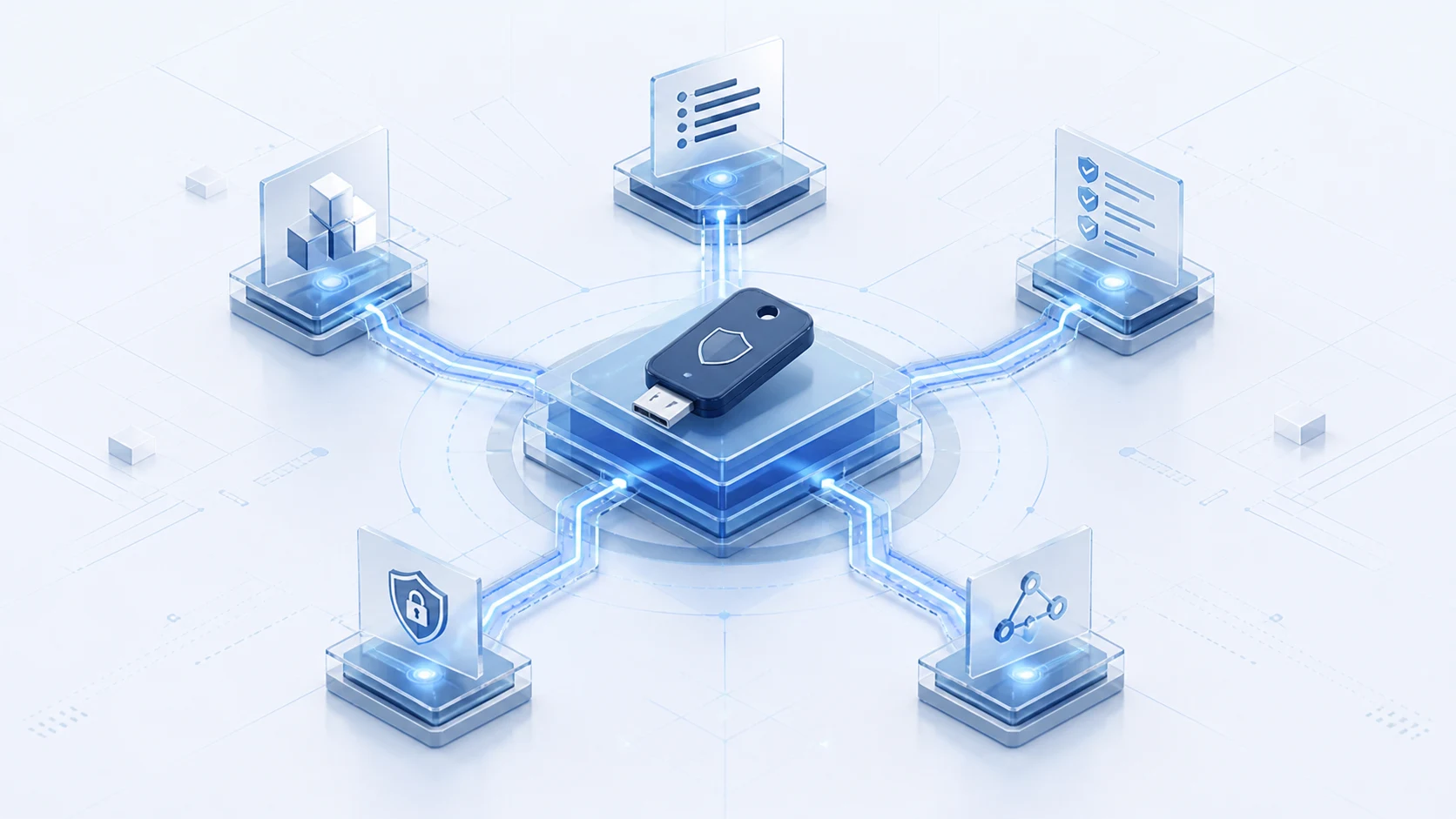
AAMVA verification, often discussed as an "AAMVA check" or "DMV database check," is one of the more useful authoritative-source checks available for U.S. driver license and state ID verification. It can confirm whether submitted driver license or ID attributes match records held by the issuing motor vehicle agency. Used correctly, it helps detect completely fabricated licenses, altered data, and some forms of synthetic identity fraud.
It is not, however, a complete identity verification system. A passed DMV database check does not prove the card in front of the camera is physically genuine. It does not prove that the person presenting the card is the rightful owner. It does not return the state record, photo, or signature to the relying party. It is best understood as a high-value attribute validation signal that should be combined with document authentication, biometric binding, device risk, and transaction context.
This guide explains how AAMVA Driver License Data Verification (DLDV) works, why it is valuable, where it fails, and how identity teams should think about it in a modern fraud program.
What AAMVA DLDV Actually Checks
The American Association of Motor Vehicle Administrators describes the Driver License Data Verification service as a way for authorized commercial and government entities to verify driver license, permit, and ID information against data from the issuing agency. In practice, the relying party submits data from the credential, and DLDV returns match or no-match indicators for the submitted elements.
That architecture matters. DLDV is not a public searchable DMV database. It is a routed verification service that checks submitted values against the issuing jurisdiction. A response tells you whether the data you sent matches what the jurisdiction can verify, not what the jurisdiction's record says.
Typical fields can include:
- Document number
- Issuing state
- First, middle, and last name
- Date of birth
- Address components
- Issue date and expiration date
- Eye color, height, weight, and sex or gender code
- Document category, such as driver license, permit, or ID card
The privacy model is one of the strongest parts of the system. AAMVA's public DLDV overview states that the service returns true or false indicators for each submitted attribute and does not return the actual jurisdiction data, verify a photo or signature, validate the physical document, or store request and response data.
Why DMV Database Checks Are Valuable
The main benefit is authoritative-source validation. NIST SP 800-63A-4 identifies state departments of motor vehicles as examples of issuing sources for driver license data and names AAMVA DLDV as an example of a service that provides or enables direct access to issuing sources.
That makes AAMVA checks different from ordinary data-broker lookups. A credit-header or public-records match can be useful, but it may reflect stale, inferred, or aggregated data. A DLDV check asks whether the submitted license or ID attributes align with the issuing agency's records.
The strongest use cases are:
- Detecting fully fabricated driver license numbers that do not exist in the issuing jurisdiction
- Detecting altered licenses where the document number is real but the name, date of birth, or other attributes were changed
- Reducing reliance on barcode parsing alone
- Adding an authoritative signal to automated ID review
- Separating likely data entry or OCR issues from more serious document or identity risk
This is especially useful when a counterfeit card looks visually plausible. A high-quality fake can copy layout, hologram placement, PDF417 barcode structure, and state-specific design cues. If the data does not exist at the DMV or does not belong together, an authoritative-source check can catch what visual inspection misses.
What AAMVA Verification Does Not Prove
The most important limitation is that DLDV validates data, not the whole identity event.
A true response can mean the document attributes match the issuing jurisdiction, but it does not necessarily mean:
- The physical card is genuine
- The card has not been copied, replayed, or digitally manipulated
- The applicant is the rightful holder
- The person in the selfie matches the DMV photo
- The card is currently in the possession of the real owner
- The presented image or video came from a live camera rather than an injected source
This distinction is easy to miss in product discussions. AAMVA verification is an evidence validation tool. It is not, by itself, identity verification. NIST separates evidence validation from identity verification, where the goal is to establish that the applicant presenting the evidence is the same person to whom the evidence was issued.
That is why AAMVA checks should be paired with controls that answer different questions:
| Question | Better control |
|---|---|
| Does the submitted license data match issuer records? | AAMVA DLDV |
| Is the physical or digital document authentic? | Document security feature analysis, barcode consistency checks, NFC or signed digital evidence when available |
| Is the presenter the rightful holder? | Biometric comparison, liveness, attended review, account or credential possession checks |
| Is the session trustworthy? | Device integrity, IP reputation, behavioral analytics, replay and injection detection |
| Is the user risky despite a valid ID? | Fraud graph, sanctions or watchlist screening, transaction risk, velocity checks |
Coverage Gaps Matter
Coverage is one of the most practical issues with AAMVA verification. Some jurisdictions participate broadly, some participate with restrictions, and participation can change over time.
As of May 1, 2026, AAMVA's public technology systems participation map for DLDV shows these high-level categories:
| DLDV category | Jurisdictions shown |
|---|---|
| Participating - no restrictions | 44 jurisdictions |
| Participating - SSA only | California, Louisiana, Minnesota, New York, Utah |
| Participating - limited use cases | Pennsylvania |
| Under review | Alaska |
That means a verification strategy must be coverage-aware. California, for example, is too large to treat as an edge case. If a high-risk workflow assumes every U.S. driver license can be checked with the same authoritative DMV signal, attackers will eventually learn which issuing states create weaker paths.
The right response is not to abandon AAMVA checks. The right response is to avoid making them the single gate. For unsupported, restricted, or unavailable jurisdictions, a workflow should increase confidence through other authoritative or high-integrity checks, such as stronger document inspection, passport chip verification when available, trusted account verification, additional biometrics, or manual review for high-risk events.
Uptime and Maintenance Are Real Operational Concerns
DLDV depends on multiple components being available. A request may involve the relying party, AAMVA services, AAMVAnet, and the issuing jurisdiction's systems. A failure in any required component can prevent a verification from completing.
AAMVA publishes system maintenance windows for DLDV and notes that DLDV production maintenance occurs Sunday from 2:00 a.m. to 5:00 a.m. Eastern Time and when the queried jurisdiction is unavailable. AAMVA also publishes jurisdiction production maintenance schedules, and those windows vary significantly by state. There have been many cases where states have unexpectedly gone offline for extended periods of time, making it difficult for relying parties to complete verifications.
This introduces operational complexity:
- A no-match is different from an unavailable jurisdiction.
- A timeout is different from a failed data match.
- A restricted jurisdiction is different from a temporarily down jurisdiction.
- A retry later may succeed when a real-time check could not complete.
Identity systems should distinguish these outcomes in policy. Blocking every unavailable check can create unnecessary customer friction. Passing every unavailable check can create a fraud gap. The better pattern is to route the user based on risk: retry later for low-risk events, step up the proofing method for high-risk events, and preserve enough audit detail to explain the decision.
False Mismatches Can Come From Data Quality
Small data differences can create failed matches. This is particularly important when the data submitted to DLDV comes from OCR, barcode parsing, a user's manual entry, or a document image with glare, blur, compression, or cropped fields.
Common mismatch sources include:
- Spaces, separators, or OCR mistakes in the driver license number
- Name variations, such as hyphenation, apostrophes, suffixes, middle names, or truncated long names
- Name comparison limits where only the leading portion of a first, middle, or last name is evaluated
- Recently changed addresses that have not propagated cleanly
- Weight or physical descriptors that were outdated when the card was issued
- Date parsing issues between formats
- ZIP+4 handling
- Barcode data that differs from the printed front of the card
The DLDV specification's matching model is built around element-level indicators and name matching logic, including fuzzy name signals. That is useful, but relying parties still need disciplined input normalization and review logic. A single false indicator should not always be treated the same way as a complete identity failure.
For example, a driver license number, date of birth, and last name mismatch is a much stronger fraud signal than a weight mismatch. A street address mismatch may reflect outdated DMV data, formatting differences, or jurisdiction-specific variance rather than a fake ID. Address should be useful context, not the only reason an otherwise consistent identity is denied.
How DLDV Fuzzy Name Matching Works
The DLDV specification is helpful because it shows that name matching is not only a rigid character-by-character comparison. The service can return exact name indicators and, when an exact name component does not match, separate fuzzy name indicators.
At a high level, DLDV name comparison works like this:
- Name matching ignores case differences.
- Non-letter characters are ignored for name comparison, so punctuation and spacing can be less important than the underlying letters.
- First, middle, and last names are compared using bounded leading portions of each field rather than unlimited-length strings.
- When an exact name match fails, DLDV can return fuzzy primary and fuzzy alternate match indicators.
- The fuzzy indicators use Double Metaphone, a phonetic algorithm designed to catch names that are spelled differently but sound similar.
This matters for policy design. An exact last-name mismatch with a positive fuzzy match should not be treated the same as an exact mismatch with no fuzzy similarity. A fuzzy match can indicate a spelling variant, transliteration issue, OCR mistake, hyphenation difference, or alternate pronunciation. It is still a mismatch, but it is a different class of mismatch.
A practical way to score name results:
| Name result | Practical meaning | Risk treatment |
|---|---|---|
| Exact match | Submitted name component aligns with the issuing record | Strong positive signal |
| Exact mismatch, fuzzy primary match | The value is different but phonetically close | Review with other signals, often lower risk |
| Exact mismatch, fuzzy alternate match | The value may be a looser pronunciation or spelling variant | Treat as weaker than primary fuzzy, but not the same as unrelated |
| Exact mismatch, no fuzzy match | The name component appears materially different | Higher risk, especially with DLN or DOB mismatch |
Double Metaphone is useful because U.S. identity data contains nicknames, compound surnames, transliterations, anglicized spellings, and OCR-prone characters. It is not a fraud detector by itself. It is a way to avoid overreacting to name variance while still preserving a structured signal for review.
The same principle applies to missing indicators. If a relying party does not submit a field, or a jurisdiction does not return enough data to compare that field, the result may be absent rather than false. Absence of a match indicator should not be collapsed into a failed match.
Pros and Cons of AAMVA DMV Checks
Pros
Authoritative validation: DLDV checks submitted data against the issuing agency, or a service connected to issuing sources, rather than only using third-party aggregated records.
Privacy-preserving response: The relying party receives match indicators, not the DMV's underlying record values.
Fast decisioning: When available, the check can be performed in real time and can support automated identity flows.
Strong counterfeit detection: Completely fabricated or poorly altered documents often fail because the document number and attributes do not belong together.
Better audit logic: Element-level match indicators help distinguish between a total failure, a likely data capture issue, and a narrow mismatch that may deserve review.
Cons
Not universal coverage: DLDV participation and usage rights vary by jurisdiction and use case.
Jurisdiction downtime: DMV systems have separate maintenance windows and outages that can affect real-time verification.
No photo or signature verification: DLDV does not return or compare the DMV photo or signature.
No physical document authentication: A card can contain real stolen data and still be counterfeit.
No proof of rightful possession: A fraudster using a victim's real license data may pass the database check unless other controls detect the impersonation.
False mismatches: OCR, manual entry, state-specific formatting, address variance, and stale DMV attributes can all create review-worthy failures.
How Fraudsters Can Bypass AAMVA-Only Workflows
Advanced attackers do not need to beat every control. They only need to understand which control carries the decision.
An AAMVA-only workflow is vulnerable to several attack patterns:
- Real data on a fake card: The attacker uses breached or illicitly obtained driver license data to print a counterfeit document. The data may match, but the card is not genuine.
- Lookalike presenter: The attacker recruits or selects a person who resembles the victim closely enough to pass weak selfie review. Since DLDV does not compare to the DMV photo, the authoritative database check does not catch the substitution.
- Restricted-state routing: Attackers target jurisdictions where DLDV access is restricted, unsupported, or operationally unreliable.
- Camera injection or replay: The applicant presents images or video through a manipulated device or virtual camera while the submitted data still passes.
- Outdated but valid records: The attacker exploits variance between current user-provided details and old DMV attributes to create confusion in manual review.
This is why strong identity programs use AAMVA as one signal in a layered process. Database truth is powerful, but it is not the same as live human presence, document possession, or session integrity.
A Practical Decision Framework
AAMVA verification works best when the policy engine treats each result as a specific signal instead of a binary approve or deny.
Consider this framework:
| AAMVA result | Suggested interpretation | Possible action |
|---|---|---|
| Strong match on license number, name, and date of birth | High confidence that submitted attributes belong together | Continue if document and biometric checks also pass |
| License number mismatch | High-risk data integrity failure | Deny, retry from cleaner capture, or route to review depending on context |
| Exact name mismatch with fuzzy match | Possible spelling, OCR, transliteration, or pronunciation variance | Review alongside DLN, DOB, document, and biometric signals |
| Exact name mismatch without fuzzy match | Material name inconsistency | Treat as higher risk, especially if other core fields fail |
| Narrow mismatch on address, weight, or middle name | Possible data quality or record freshness issue | Step up, request recapture, or review with other signals |
| Missing match indicator for an optional field | Field was not submitted or not available for comparison | Do not score as a confirmed mismatch |
| Jurisdiction unavailable or timeout | Operational uncertainty, not a data mismatch | Retry, queue, or step up based on transaction risk |
| Restricted or unsupported jurisdiction | Coverage gap | Use alternate authoritative checks and stronger document or biometric controls |
| AAMVA pass but document or liveness fail | High-risk inconsistency | Treat as possible real-data counterfeit or presentation attack |
The key is correlation. AAMVA should increase confidence when it agrees with other signals. It should not override serious evidence that the document image, biometric sample, or device session is compromised.
Best Practices for Implementing AAMVA Checks
-
Normalize before submitting. Clean obvious OCR and barcode parsing artifacts, especially document number separators, trailing spaces, date formats, name punctuation, and ZIP code formatting.
-
Capture from the best source. Prefer barcode or high-confidence document parsing over manual entry when possible, but compare barcode data against front-side OCR to catch tampering.
-
Separate errors from mismatches. A jurisdiction outage, timeout, authentication issue, or non-participating destination should not be treated as the same outcome as a confirmed no-match.
-
Build retry logic. Many outages are temporary and occur during published maintenance windows. Queueing or retrying can reduce unnecessary abandonment. The DLDV process describes short jurisdiction response windows, so client-side timeouts should leave room for slow jurisdiction and network responses rather than failing too early.
-
Use risk-based step-up. If DLDV is unavailable for a low-risk event, a retry may be enough. If the same happens during a high-value transfer, account recovery, age-restricted purchase, or privileged employee onboarding, require stronger proof.
-
Interpret fuzzy name results separately. Exact name failures, primary fuzzy matches, alternate fuzzy matches, and no fuzzy match should have different policy outcomes.
-
Do not over-weight address. Address data is useful, but it is often less reliable than document number, name, and date of birth. Treat address mismatches with context.
-
Pair with physical document checks. Use image analysis, barcode consistency, template validation, security feature inspection, and, where available, cryptographic document verification.
-
Bind the applicant to the evidence. Use biometric comparison, liveness, trusted referee review, or possession-based checks so a stolen identity record cannot pass on data alone.
-
Pace batch activity. If checks are queued or released in batches, rate-limit them so retries do not overwhelm jurisdiction systems or create avoidable timeouts.
-
Monitor by jurisdiction. Track match rates, outage rates, fallback rates, and fraud outcomes by issuing state. Coverage gaps become visible faster when measured this way.
-
Document the policy. For regulated environments, record why AAMVA is used, what it validates, what it does not validate, and how exceptions are handled.
Where AAMVA Fits in Modern Identity Verification
AAMVA DLDV is one of the better tools for validating U.S. driver license and state ID attributes against an authoritative source. It is especially valuable for catching fabricated data and adding issuer-backed confidence to a verification flow.
Its limits are just as important. It does not authenticate the physical card, compare the applicant to the DMV photo, or prove that the presenter is the rightful identity owner. It also has coverage restrictions and operational dependencies across jurisdictions.
The strongest identity verification programs use AAMVA checks as part of a layered model:
- Authoritative attribute validation through DLDV or comparable sources
- Document authenticity checks to detect counterfeit or altered evidence
- Biometric and liveness controls to bind the person to the evidence
- Device and session integrity checks to detect injection, replay, and automation
- Risk-based routing for coverage gaps, outages, and inconsistent signals
In that role, DMV database checks are extremely useful. They are not a silver bullet, but they are a strong signal when interpreted with the right context.
Frequently Asked Questions
Is AAMVA the same as a DMV database?
Not exactly. AAMVA DLDV is a verification service that routes submitted driver license or ID attributes for comparison against issuing-agency data. It returns match indicators rather than exposing DMV records.
Does AAMVA verification prove an ID is real?
No. It can show that submitted attributes match issuer data, but AAMVA's public overview says DLDV does not validate that the physical document is genuine and does not verify the photo or signature.
Does DLDV verify the person presenting the ID?
No. AAMVA verification does not prove that the applicant is the rightful owner of the identity evidence. That requires identity verification controls such as biometric comparison, liveness, attended review, trusted digital credentials, or other ownership checks.
Which states support AAMVA DLDV?
Participation changes, so teams should check AAMVA's public technology systems participation map. As of May 1, 2026, the public map shows 44 jurisdictions as participating with no restrictions, five as SSA-only, one as limited use, and one under review.
What should happen when AAMVA is unavailable?
Treat unavailability as an operational exception, not a confirmed mismatch. Depending on the risk of the event, retry the check, queue it, request a stronger verification method, or route the case to manual review.