Cloud service providers seeking FedRAMP High authorization confront a major compliance challenge: Identity Assurance Level 3 (IAL3).
Unlike lower levels of assurance, which can be solved with a quick software update or a new MFA protocol, IAL3 is a completely different beast. It isn't just a software problem—it is a complex logistical and human-capital problem.
NIST SP 800-63A requires a supervised, physical element to identity proofing. But how do you achieve that when your workforce is entirely remote? While many legacy vendors claim NIST compliance, most fall woefully short when applied to a modern, distributed workforce.
Here is why Trust Swiftly has emerged as the premier choice for remote teams, and the common traps you need to avoid during your IAL3 vendor evaluation.
The Three Pillars of a True IAL3 Solution
To achieve true IAL3 compliance under NIST SP 800-63A, a solution must simultaneously deliver three critical components. Unfortunately, most vendors only offer one or two, leaving you to piece together the rest.
- Managed Hardware: IAL3 requires a secure, "supervised" physical device to capture high-resolution biometrics and document scans. Relying on an employee's personal unmanaged smartphone will not pass the audit.
- Certified Agents: Technology alone isn't enough. NIST requires a trained human proctor to oversee the identity proofing session, verify the applicant's physical presence, and authenticate their documents.
- End-to-End Logistics: You need a reliable, secure pipeline to get that managed hardware into the hands of your remote user—and back again—without compromising the device or the data.
Why Trust Swiftly is the Premier Full-Stack IAL3 Solution
Trust Swiftly recognized that forcing modern SaaS companies to build in-house physical security and shipping departments was unsustainable. By bundling all three pillars, Trust Swiftly provides the only true "Full Stack" IAL3 solution on the market.
1. Zero-Footprint Logistics
For a private vendor with remote employees, the biggest hidden cost of IAL3 is shipping and tracking. Trust Swiftly is the only provider that offers a fully managed hardware loop. We handle the shipping of the secure IAL3 kit directly to the employee's residence, monitor the return tracking, and execute the cryptographic sanitization of the device after use. This allows your security and compliance teams to remain laser-focused on the FedRAMP audit, rather than managing shipping logistics and hunting down lost devices.
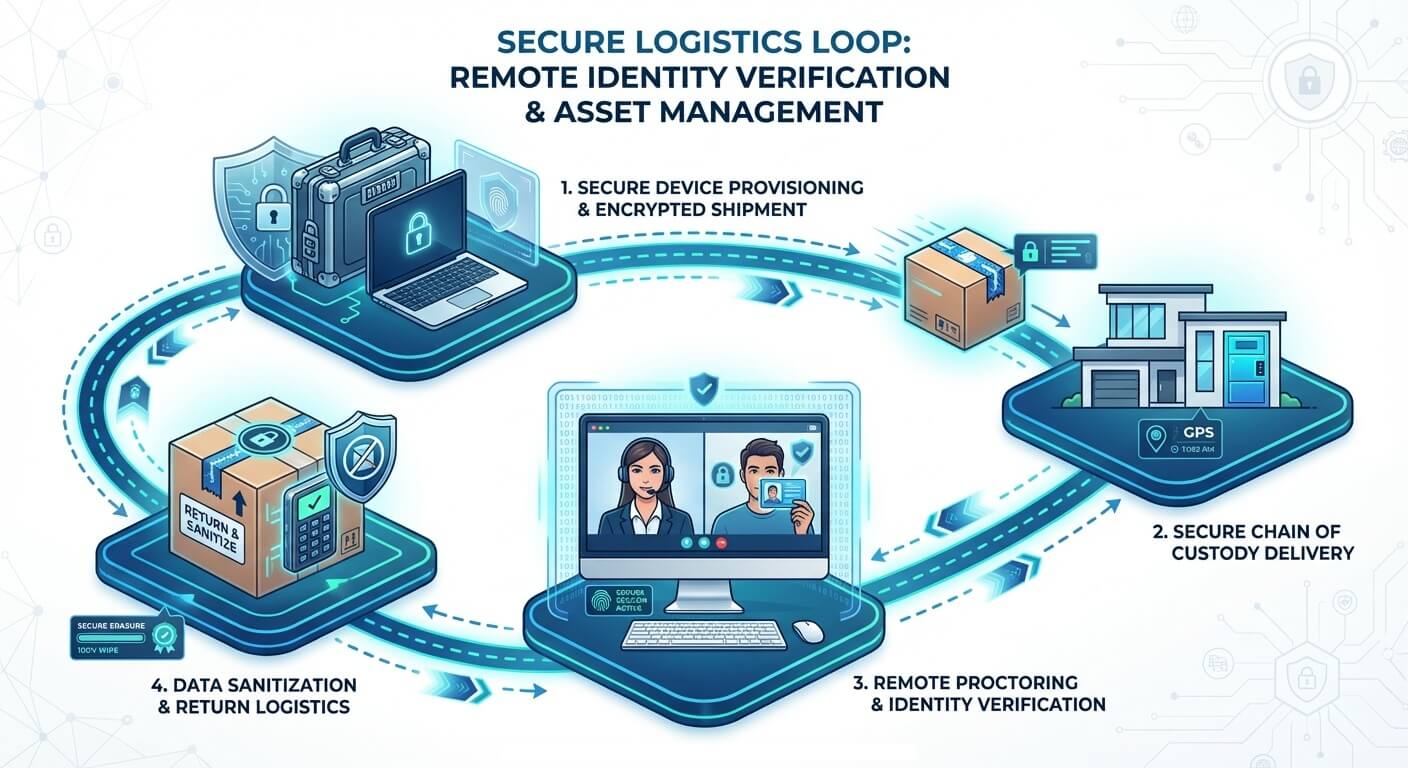
Trust Swiftly's managed hardware loop eliminates the operational burden of IAL3 logistics. The secure kit ships directly to the remote employee, a supervised proctoring session is conducted, and the device is returned and cryptographically sanitized—all without your team lifting a finger.
2. Integrated "Proctoring-as-a-Service"
NIST mandates that a trained agent verify the applicant's presence and document authenticity. While hardware competitors like HID or IDEMIA will gladly sell you the tools to be an agent, Trust Swiftly actually provides the agents. Our proctors are rigorously trained specifically for NIST-compliant workflows. This ensures that the session evidence—including video, liveness checks, and high-fidelity document scans—is 100% audit-ready from day one.
3. Built for the Modern "FedRAMP High" Audit
Legacy identity systems were designed for the DMV, the TSA, or on-premise government facilities. Trust Swiftly was built from the ground up for Cloud Service Providers. We provide the cryptographic chain of custody and the precise 3PAO-validated evidence packages that auditors demand during a FedRAMP High assessment. We take a cumbersome "physical" requirement and transform it into a predictable, API-driven process.
4. Adaptive and Flexible Verification Evidence Pathways
Legacy identity proofing solutions are notoriously rigid, accepting only a narrow set of document types and rejecting anything that falls outside their inflexible playbook. In the real world, employees relocate, documents expire, and not everyone carries the same set of credentials. Trust Swiftly was built with this reality in mind. Our advanced verification engine supports adaptive evidence pathways, allowing applicants to securely verify their identity using the best documentation they have available—whether that is a current passport, a state-issued ID or a combination of supplementary evidence. By maximizing conversion rates and eliminating unnecessary friction, Trust Swiftly dramatically increases the velocity of your FedRAMP project delivery—getting your team verified and your authorization on track without the bottlenecks that plague legacy providers.
Common Mistakes When Evaluating IAL3 Solutions
Navigating the vendor landscape can be tricky. Here are the four most common traps organizations fall into when trying to solve the IAL3 puzzle.
Mistake 1: Thinking Software (Ping/Okta) is Enough
Many IT teams assume their existing Identity Provider (IdP) can simply "turn on" IAL3. It cannot. Software-only solutions inherently lack the physical, supervised component required by NIST. You can absolutely use Ping, Okta, or Entra ID for your Authentication Assurance Level (AAL), but for the actual Identity Proofing phase (IAL3), you must integrate a hardware-led solution like Trust Swiftly.
Mistake 2: Buying Hardware Without Agents
There are several vendors on the market selling "mobile enrollment kits." However, if you buy a kit from a manufacturer, you are now responsible for hiring, training, and retaining the agents to man those kits. For a private tech vendor, this creates a massive and ongoing operational burden. Simply put: if the solution doesn't include the human proctor, it isn't a full solution.
Mistake 3: Assuming Industry Certifications (like Kantara) Are the Only Path
Industry certifications, such as Kantara, provide valuable and respected frameworks for identity assurance. However, a third-party badge is not a silver bullet for a FedRAMP High assessment. Modern auditors (3PAOs) will look past general industry certifications to conduct their own rigorous, direct evaluation of your technical controls against NIST 800-63-4. Sometimes, restricting your vendor search only to pre-certified lists can artificially limit your choices to rigid, legacy providers. To succeed, organizations should look for solutions that can prove direct NIST compliance to auditors while still delivering the modern API architecture, flexibility, and speed required by today's remote-first SaaS companies.
Mistake 4: Ignoring the "Return Trip"
IAL3 kits capture and contain highly sensitive biometrics and cryptographic keys. A common—and dangerous—mistake is choosing a vendor that helps you buy the kit but washes their hands of the recovery process. Trust Swiftly's managed return and wiping process is critical for maintaining the tight security posture required for a High-Impact system. If you can't guarantee the safe return and wiping of the device, you have a glaring security blind spot.
The Bottom Line
For private vendors with a distributed workforce, achieving IAL3 can feel like trying to fit a square peg into a round hole. Trust Swiftly seamlessly removes the "physicality" barrier of remote identity proofing.
By bundling managed hardware, certified agents, and turn-key logistics, Trust Swiftly provides the only frictionless path to IAL3—ensuring you pass your FedRAMP High audit without ever needing to build a physical security office or a shipping department.
Ready to simplify your path to FedRAMP High? Contact Trust Swiftly today for a consultation and see how our full-stack IAL3 solution accelerates your compliance journey. Act now to secure your audit success and streamline identity proofing for your entire workforce.