
Introduction: The "Moderate" Trap
For Cloud Service Providers (CSPs) pursuing FedRAMP Moderate, the path of least resistance is tempting. The baseline requirement typically points to NIST SP 800-63 Identity Assurance Level 2 (IAL2) for standard users. It is automated, remote, and compliant.
However, compliance does not always equal security.
As threat actors increasingly target the "keys to the kingdom"—your system administrators, DevOps engineers, and boundary super users—relying on standard identity proofing for your most privileged staff is a critical vulnerability.
At Trust Swiftly, we are seeing a shift in the industry. Forward-thinking CISOs and compliance officers are moving beyond the minimums. They are implementing IAL3 (High Confidence) identity proofing for privileged accounts within Moderate environments. Here is why your organization should do the same.
The FedRAMP Risk Reality: Why IAL2 Isn't Enough for Admins
Under the FedRAMP Moderate baseline, a standard user accessing a web portal and a Root Administrator managing the entire authorization boundary often fall under the same technical requirement: IAL2.
This is a logical disconnect. If a threat actor compromises a standard user, data loss is limited. If they compromise a boundary super user, they own the infrastructure.
Modern guidance, including the recently released NIST SP 800-63-4, emphasizes that identity assurance should be driven by risk, not just baseline checklists.
Targeted Attacks: Privileged accounts are the primary target for advanced persistent threats (APTs).
Deepfakes & AI: Remote, automated IAL2 checks (selfie + ID scan) are increasingly vulnerable to sophisticated AI-generated deepfakes.
The Insider Threat: The most dangerous actor is the one already inside the perimeter.
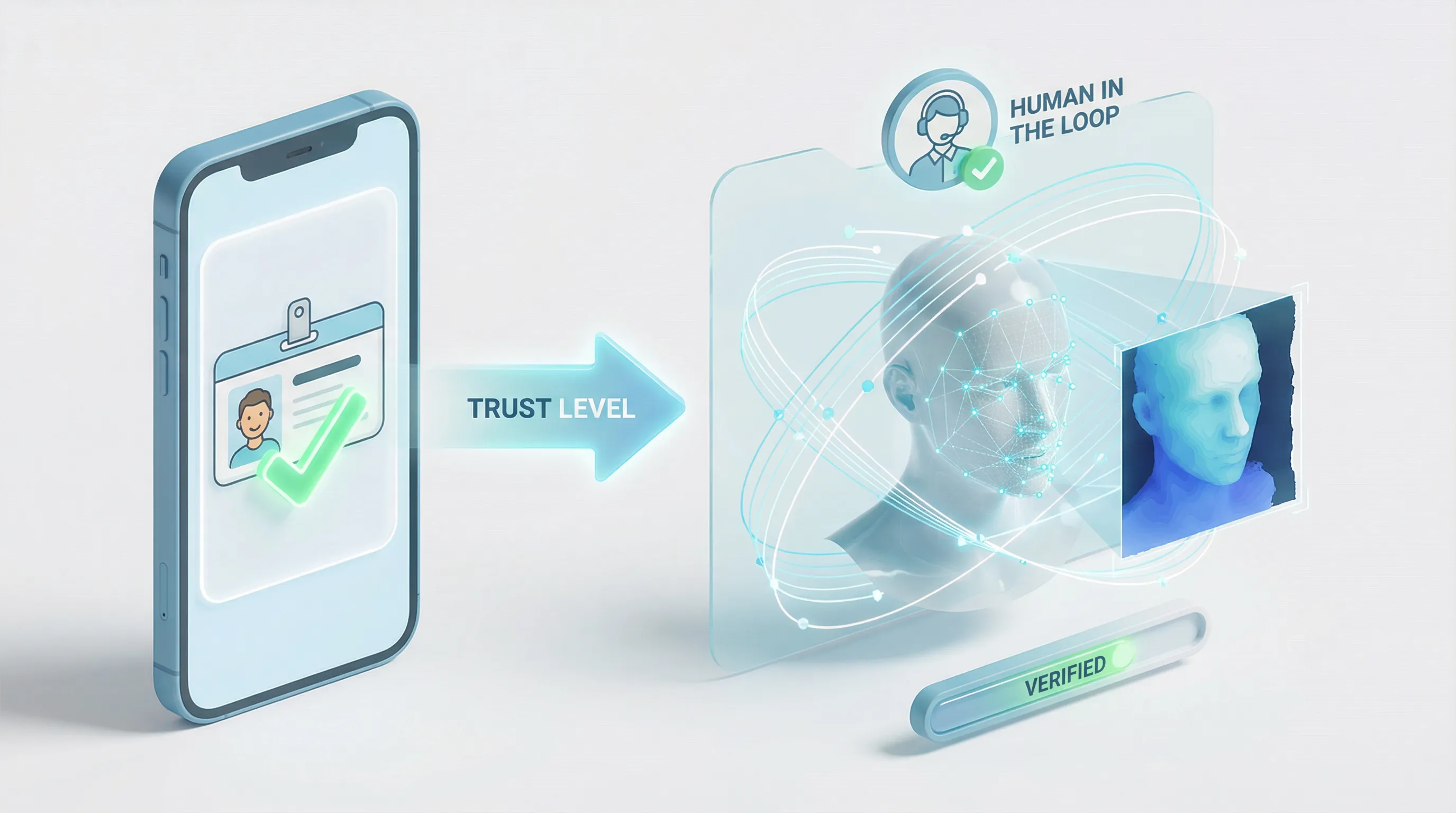
Best Practice: While your general user base may remain at IAL2, your privileged staff should be held to the IAL3 standard—requiring supervised remote or in-person biometric verification to ensure the person holding the keys is exactly who they claim to be.
Navigating Controls IA-12 and PS-3
To pass your audit and secure your environment, you must look closely at two critical controls: IA-12 (Identity Proofing) and PS-3 (Personnel Screening).
IA-12: The Flexibility of Revision 5
FedRAMP Moderate directs you to follow NIST SP 800-63A. The latest revision allows for flexibility but mandates that agencies and CSPs perform a Digital Identity Risk Assessment. In the latest traceability template released the focus has shifted towards risk-based identity proofing. The requirements state (IA-12a.): "Determine if users who require accounts for logical access to systems based on appropriate identity assurance level requirements as specified in applicable standards and guidelines are identity proofed" means that you will now have IAL3 verification requirements for your team.
If your assessment identifies that specific roles (e.g., Database Admins) have access to sensitive PII or critical infrastructure data, sticking to IAL2 may be deemed an "unacceptable risk" by a rigorous auditor.
Implementing IAL3 for these specific roles demonstrates a mature security posture that exceeds basic compliance.
Not sure if your current controls meet the IA-12 rigor? Check your IAL3 compliance posture with our team.
PS-3: The Personnel Security Factor
Control PS-3 requires personnel screening. However, a gap exists: many HR departments conflate Background Checks with Identity Proofing.
Background Checks verify history (criminal records, credit, employment). They rely on static databases.
Identity Proofing (IAL3) verifies the human.
The Gap: A background check cannot tell you if the remote engineer logging in from Florida is actually a sanctioned actor from North Korea using a stolen identity (a scheme explicitly warned against in recent FBI and DOJ advisories). Only IAL3, with its requirement for supervised verification and biometric binding, can effectively stop this modern "Remote IT Worker" fraud.
Future-Proofing: The Path to FedRAMP High
Many CSPs currently at the Moderate level have roadmaps to eventually achieve FedRAMP High.
FedRAMP High explicitly requires IAL3 for authentication and identity proofing.
By implementing IAL3 for your core team now, you eliminate a massive hurdle for your future High authorization.
With Trust Swiftly, you don’t have to choose one or the other. Our platform is dynamic. You can configure IAL2 workflows for your standard users to minimize friction, while enforcing strict IAL3 workflows for your internal admins and privileged users—all within the same dashboard.
Many CSPs fear IAL3 adds friction. However, applying IAL3 only to privileged users via Trust Swiftly's dynamic logic ensures the user experience remains smooth for 99% of your customer base while locking down the critical 1%.
Why Background Checks Are Not Enough
We frequently hear from HR teams: "We already did a background check."
Background checks are retrospective; they look at data. Identity proofing is current; it looks at the person. In an era where "North Korean IT Worker" schemes are infiltrating Fortune 500s and government contractors, relying solely on a Social Security Number trace is negligence.
Trust Swiftly’s IAL3 solution bridges this gap. We provide the biometric certainty that the person you screened is the person accessing your boundary.
Conclusion: Secure the Boundary, Not Just the Checkbox
For FedRAMP Moderate environments, IAL2 is the floor, not the ceiling.
If you are an Auditor, CISO, or Compliance Officer, ask yourself: Is IAL2 enough protection for the person who has root access to our entire cloud environment?
The honest answer is no. IAL3 is the only way to trust these high-valued employees.
Trust Swiftly empowers you to deploy the right level of security for the right role. Secure your privileged users with IAL3 today, and make your next audit—and your future transition to FedRAMP High—seamless.
Ready to elevate your Identity Assurance?
Contact Trust Swiftly to learn how our dynamic IAL2/IAL3 verification platform can secure your FedRAMP Moderate environment against insider threats and identity fraud.